When a buyer asks for "your details", many businesses send a heavy PDF on WhatsApp and hope for the best. That can work, but it is no longer the only option. A digital catalogue lets customers browse your products on any phone, and you can update it the same day your price list or range changes.
So which one do you need: a digital catalogue, a PDF company profile, or both? This guide explains the difference in plain language.
What is a PDF company profile?
A company profile is a document that introduces your business. It usually covers who you are, what you make or offer, your infrastructure, certifications, key clients and contact details. It is meant to build trust, which makes it useful for tenders, vendor registrations, export enquiries and first meetings.
A PDF is easy to attach to an email, works offline and looks the same on every device.
What is a digital catalogue?
A digital catalogue (also written "digital catalog") focuses on your products. It can be a flipbook, a web-based catalogue or a full catalogue website. Visitors can browse categories, view images and specifications, and contact you directly from a product.
Because it lives online, you share it with a link, update it any time and see which pages get attention.
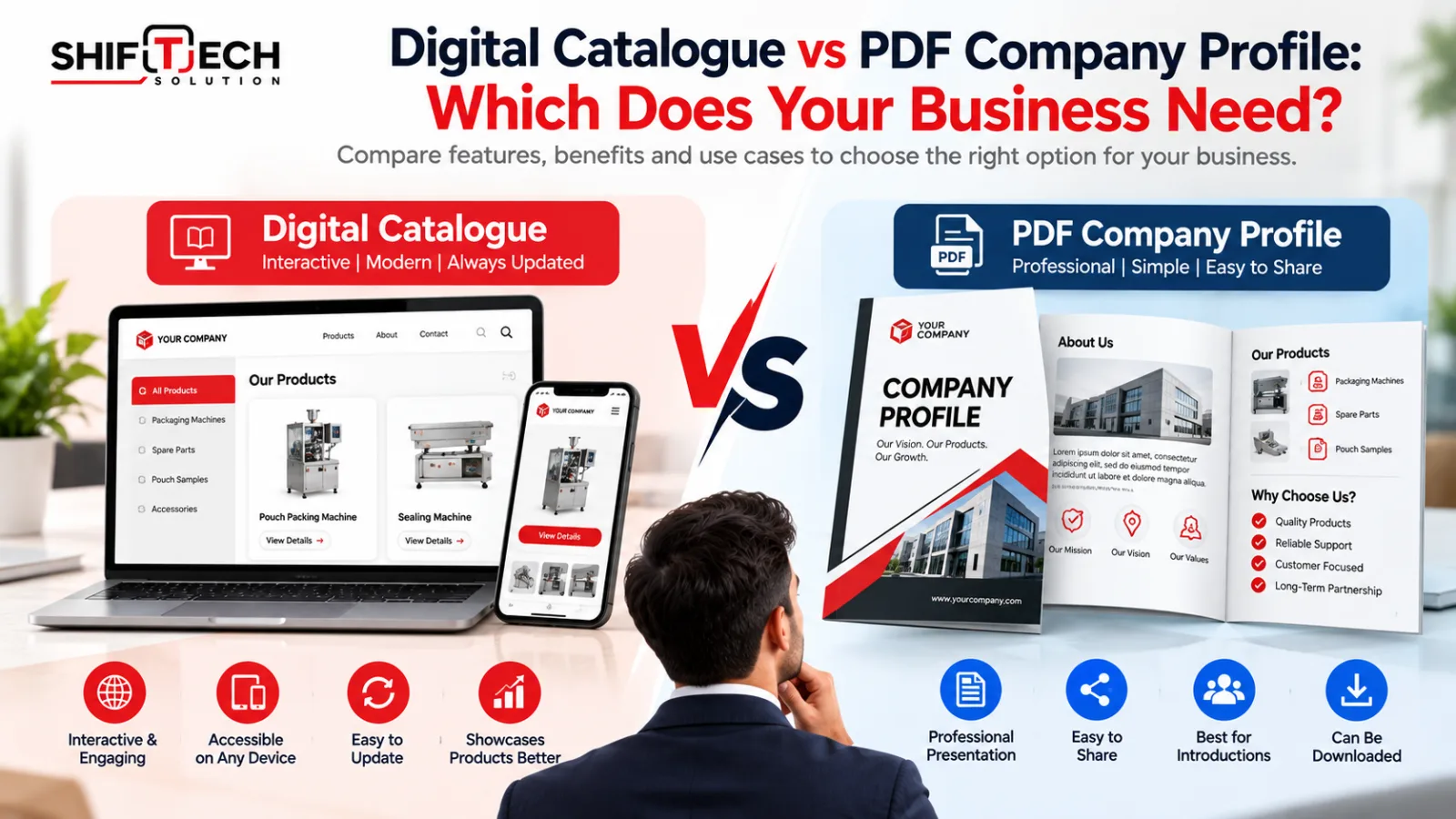
Digital catalogue vs PDF company profile
- Purpose: the profile builds trust in your company. The catalogue helps customers choose products.
- Updating: a PDF must be re-created and re-sent. A digital catalogue is updated in one place.
- Sharing: both work on WhatsApp, but a link is lighter than a large file.
- Mobile experience: a well-built catalogue adapts to the screen. A PDF often needs pinch and zoom.
- Tracking: online catalogues can show visits and enquiries. PDFs usually cannot.
- Search visibility: a catalogue built as web pages can bring in customers from Google. A PDF has limited reach.
Which one should your business use?
Use a PDF company profile if you regularly respond to tenders, vendor forms or formal enquiries and need a document to attach.
Use a digital catalogue if you have many products, change prices or ranges often, or want customers to find you online.
Use both if you are a manufacturer, exporter or distributor. A short profile builds trust, and a live catalogue shows what you sell.
What a good digital catalogue includes
- Clear categories and a simple menu
- Sharp product images and key specifications
- An enquiry or WhatsApp button on each product
- Fast loading on mobile networks
- A downloadable PDF version for people who prefer it
How to share your catalogue with customers
Whatever format you choose, make it easy for the buyer to open it:
- Send a short link on WhatsApp instead of a large file, and add one line saying what they will find inside.
- Put the catalogue link in your email signature, your Google Business Profile and your social media bio.
- Add a QR code on your visiting cards, packaging and exhibition stalls so people can open the catalogue on their phone.
- Keep a lighter PDF version ready for buyers on slow connections or those who need to forward it internally.
Mistakes to avoid
- Sending a 50 MB PDF that does not open on a phone
- Mixing company history and the full product range in one confusing document
- Leaving old prices and discontinued products in circulation
- Using small images that look blurry when zoomed
- Not including an easy way to contact you from the catalogue
A catalogue only works if the buyer can find the product they want in a few taps, and then reach you without hunting for your number.
Examples from our work
We have built catalogue-style websites for export and pharma businesses, including Vision Exports Global and Nova Remedies. Each one was designed so buyers can browse products and send enquiries quickly.
If you need a profile or catalogue that matches your brand, see our logo, branding and graphic design service or our website design and development service. You can also talk to our team on the contact page.