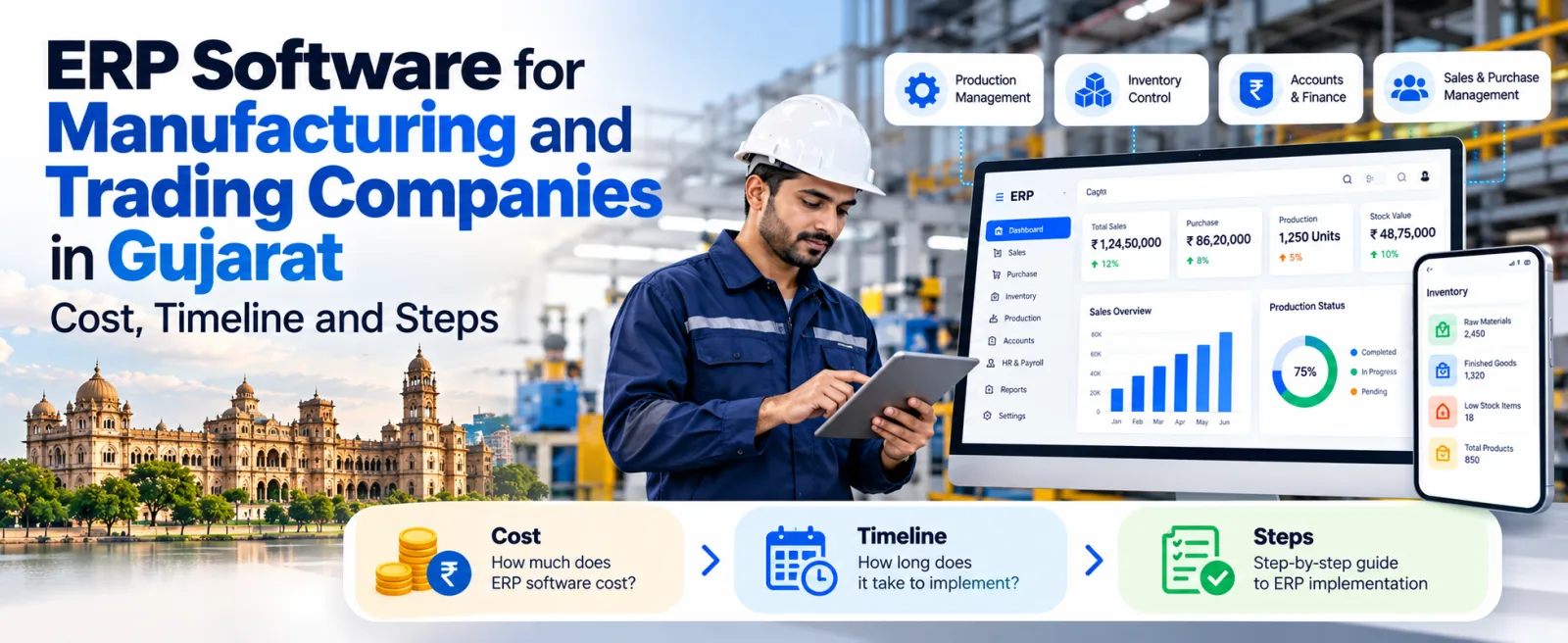
Gujarat's manufacturers, distributors and traders often outgrow spreadsheets and basic billing tools at around the same point: more products, more branches, more staff and more compliance. An ERP brings sales, purchase, stock, accounts and reports into one system.
What an ERP typically covers
- Sales, quotations and dispatch
- Purchase, vendor management and approvals
- Inventory across godowns and branches, with batch or lot tracking where needed
- Accounts, ledgers, outstanding and GST reports
- Production or job-work tracking for manufacturing units
- HR inputs such as attendance and payroll data
How much does ERP cost?
Costs vary with the number of modules, users, branches and integrations. Focused custom modules such as billing and inventory start around ₹15,000 with us. A complete multi-module ERP is priced after a discovery call, because a trading business and a manufacturing unit are very different projects. Be wary of quotes that do not ask about your workflow.
How long does implementation take?
A focused rollout usually takes 4–8 weeks. Larger multi-branch systems are best delivered in phases so your team benefits early.
The steps of a good ERP project
- Discovery — map current workflows, spreadsheets and pain points.
- Prototype — review working screens before full development.
- Build and migrate — develop module by module and import your master data.
- Train — hands-on training for each role.
- Go live and support — parallel run if needed and responsive support.
Common mistakes to avoid
- Trying to launch every module at once instead of phasing.
- Skipping staff training.
- Not cleaning your product and customer data before migration.
- Choosing software that cannot adapt when your process changes.
Planning an ERP? See our ERP software development page or book a discovery call.